Page 2 of 2
Re: Even Better PureSignal Performance on your Apache Labs radio
Posted: Sat Feb 07, 2026 5:57 pm
by K1LSB
Wow!!
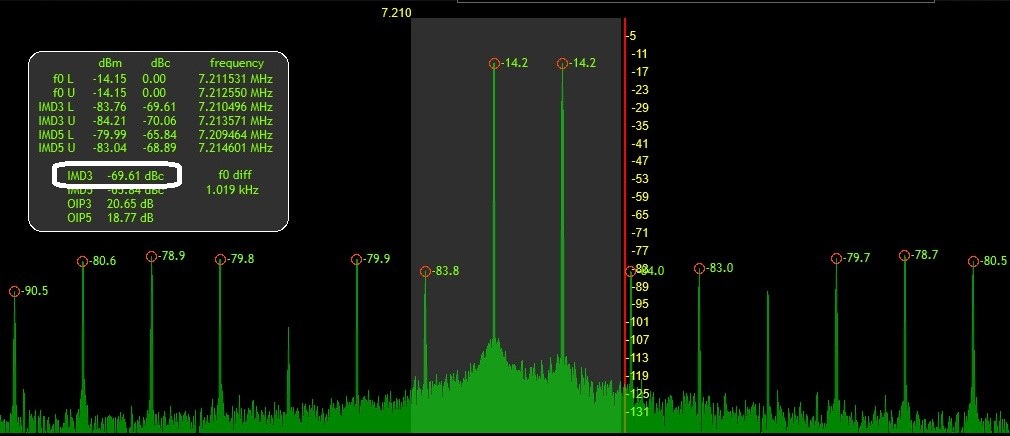
After some experimenting with two-tone frequencies I was able to improve my IMD3 by more than 6 dB on 40 meters (as measured in Thetis)!
Per my Thursday post in this thread I had measured an IMD3 of -63.26 dBc on 40 meters at 81 watts into a dummy load, using 1143 and 1969 as my two-tone frequencies.
Today I ran the exact same test again, but this time I was using 943 and 1969 as the two-tone freqs, and now Thetis says my IMD3 is -69.61 dBc!
- Capture-1.jpg (81.71 KiB) Viewed 32 times
That snapshot was taken after letting the test stabilize for 5 seconds.
The only change I made between yesterday and today was to modify one of the two-tone frequencies.
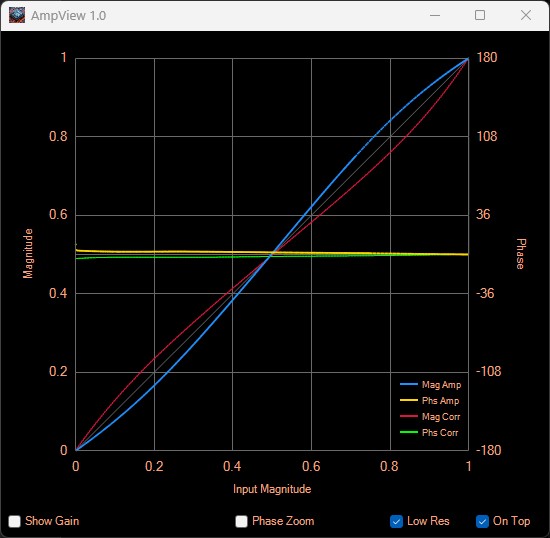
FWIW, here's my AmpView graph at the time of the test.
- Capture-4.jpg (45.51 KiB) Viewed 32 times
Mark
Re: Even Better PureSignal Performance on your Apache Labs radio
Posted: Sat Feb 07, 2026 7:21 pm
by w-u-2-o
You are not "improving" your results by doing this unless that you can show that performing a PS single cal operation with those specific tones causes the IMD products with a real-world signal, like human speech in SSB mode, are better than performing a single cal with the standard 700 & 1900 Hz tone pair. And, if during normal operations, you are using PS automatic mode instead of single cal, the performance obtained with a given tone pair (standard or otherwise) is only an approximation of the real world performance.
To compare results both parties must use the same tone pair. The selection of tone frequencies is somewhat arbitrary and may vary depending on the specific measurements being made, but in all cases the tones should be harmonically unrelated, and in most cases (not all) the same amplitude.
Just to muddy the waters further

consider the following list of commonly used tone pairs:
- 700 Hz and 1900 Hz: Common for audio equipment (and the default for Thetis).
- 60 Hz and 7 kHz: Standard SMPTE IMD test.
- 19 kHz and 20 kHz: Standard for measuring high-frequency IMD in audio.
-Fc ± 5-10 MHz: Common for high-frequency RF systems.
Re: Even Better PureSignal Performance on your Apache Labs radio
Posted: Sat Feb 07, 2026 7:48 pm
by K1LSB
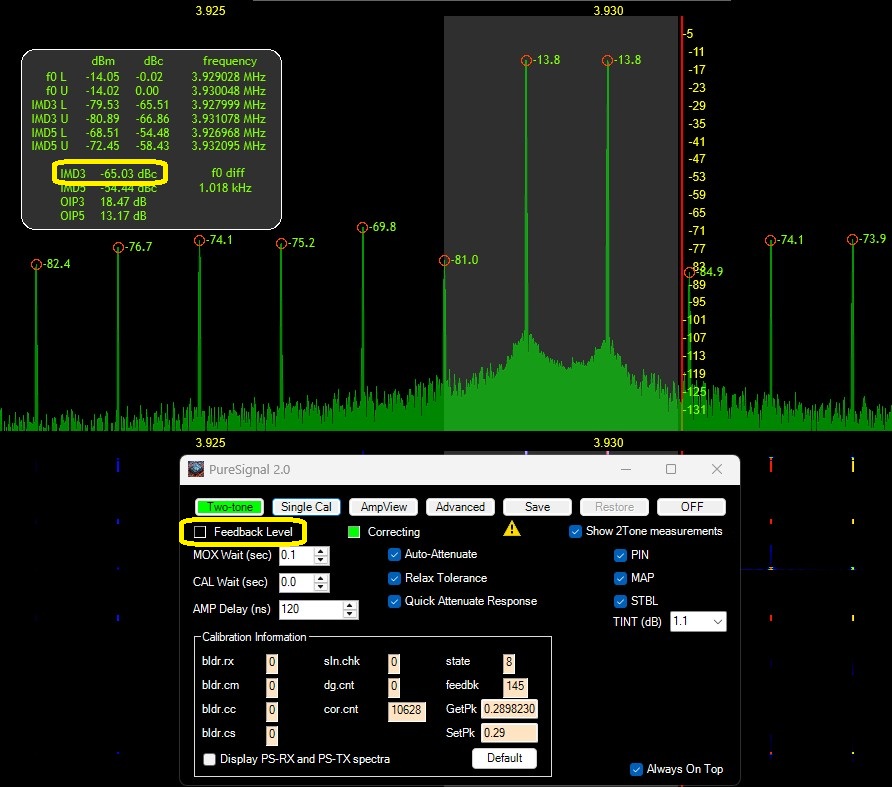
Okay, here's a screenshot of a full 100 watts out to a dummy load on 80 meters just a moment ago, using Single Cal (notice the "feedback Level" in the Linearity window is
not lit, proof that Single Cal is in effect).
The -65dBc IMD3 reading is much better than any of the charts in this thread show for 80 meter measurements.
- Capture-3.jpg (145.35 KiB) Viewed 27 times
And you haven't explained why using different two-tone frequencies can produce different results, you simply implied that the improved results I'm seeing aren't meaningful.
Mark
Re: Even Better PureSignal Performance on your Apache Labs radio
Posted: Sat Feb 07, 2026 8:11 pm
by w-u-2-o
Mark--unfortunately that screen shot proves nothing, other than the PureSignal algorithm can obtain better results with that tone pair vs. other tone pairs. It's irrelevant if spoken audio is used in automatic mode, and probably irrelevant in any case.
To prove your selected tone pair has any real value for IMD improvement then you have to perform the experiment that I described. This is not that hard. You can use the peak hold feature of Thetis to capture the spectral response obtained with human speech on SSB while using a given single cal result. Ideally it would be best to use the same recording for each measurement, but I suspect it won't matter that much.
Re: Even Better PureSignal Performance on your Apache Labs radio
Posted: Sat Feb 07, 2026 8:59 pm
by K1LSB
Scott,
I'm not sure what experiment it was that you described...if you're referring to comparing test results using my new two-tone frequencies to the old test results using different frequencies, I've already done that on multiple different bands and posted the results in multiple threads in this forum.
I have no idea why you (or anyone else) are such an advocate of Single Cal. That feature is nothing more than a one-time correction curve calculator, and thus renders the very notion of "adaptive predistortion" effectively meaningless.
As I've said repeatedly, I always let PureSignal correct in real-time for any changes in the measured nonlinearity in my voice transmissions. That's what it's made for!
My strong contention has always been that Single Cal will not produce the cleanest signal during voice TX at any given instant, precisely because Single Cal is not real-time "adaptive" correction!
With that said, I do of course realize that any particular choice of two-tone frequencies has absolutely no bearing on the real-time (not Single Cal) operation of PureSignal.
Mark
Re: Even Better PureSignal Performance on your Apache Labs radio
Posted: Sat Feb 07, 2026 9:11 pm
by K1LSB
I have to go ride my bicycle while this awesome weather is here, I'll be back later.
Mark